



How brand building offsets rising performance marketing costs
Short answer: brand doesn’t replace performance marketing. It makes every euro of it work harder. A brand that people already know and like converts more of the clicks you pay for, needs fewer of them, and gets recommended by AI assistants without you bidding at all. For a consumer SME, the practical route is to prime people before they search (emotional, distinctive, consistent brand-building) and prove yourself when they, or a machine, check (clear, consistent, verifiable brand information). Fund it by moving a small, measured slice of performance budget, not by starting a second marketing department.
The meeting where the numbers overshadowed the real problem
Not long after I joined a decades-old nutrition brand, I sat in a performance marketing update meeting with our growth partner at the time. Revenue and new-customer numbers had fallen below where they’d been a year earlier and the team was working towards reversing this trend. The story was not great: the cost of winning a new customer wasn’t ideal, the channel mix wasn’t moving in a healthy direction, and the answer was not the one I wanted to hear: Spend more, lean in on discounting and sales.
Then I asked the room a different question: who is our customer? Not the audience segment. The person.
Each person gave me a different answer, yet all worked on the same brand.
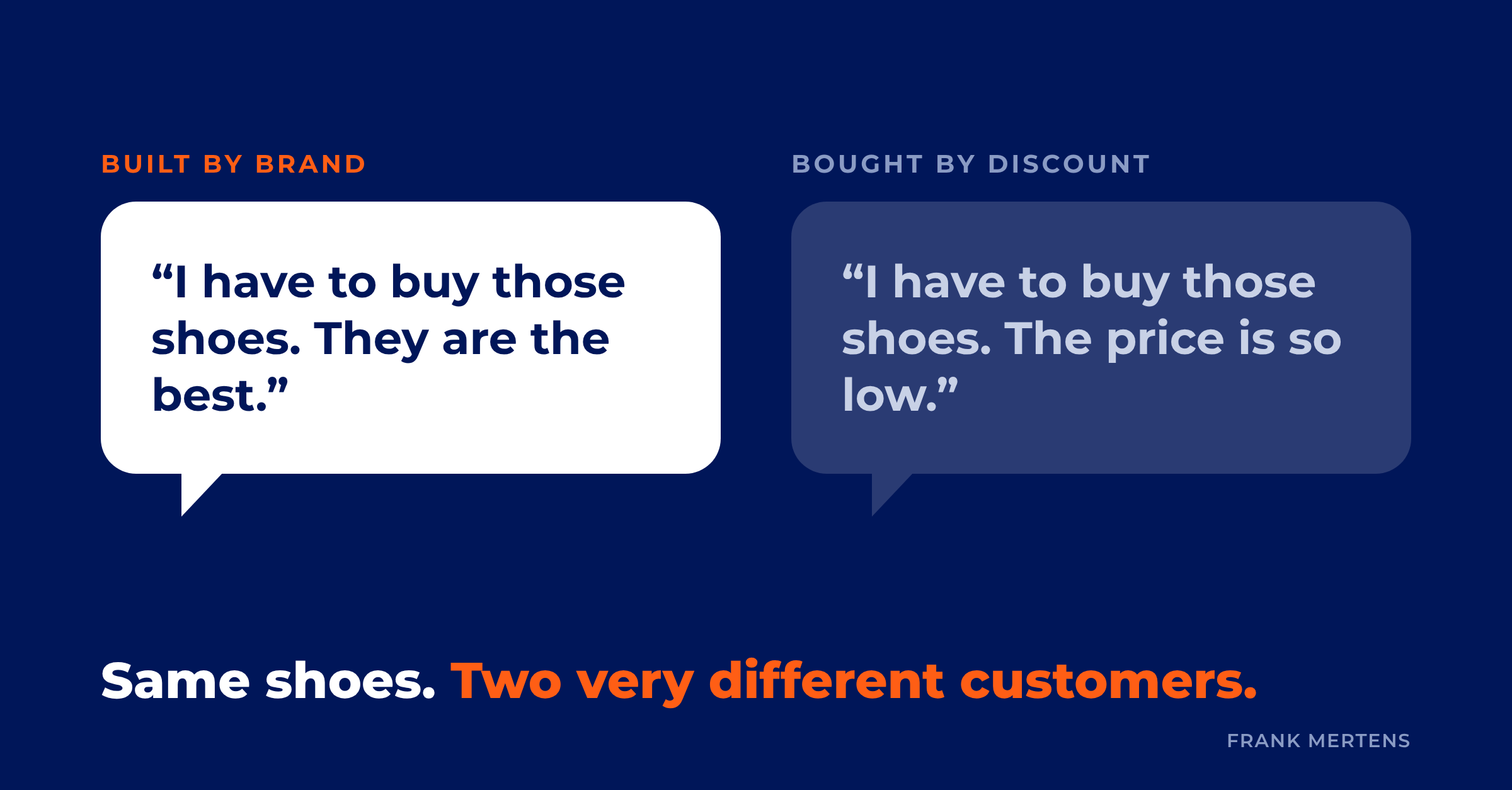
That was the real problem. We had become very good at buying clicks from people we didn’t really know, at finding the discount that drove behaviour, and subsequently costs to acquire kept getting higher.
Why performance marketing keeps getting more expensive
This isn’t just your agency’s excuse. Meta’s own results show the average price per ad across its apps rose 9% year-on-year in 2025, and 6% in the fourth quarter alone, while it served 12% more ad impressions over the year (Meta, Q4 and full-year 2025 results, January 2026). More ads, each one more expensive. Every consumer brand bidding into the same auctions pays that inflation.
When the only lever you pull is the one everyone else is pulling, your costs are set by the auction, not by you.
What the evidence says about brand and performance
The best-known evidence is Les Binet and Peter Field’s work for the IPA. Analysing close to a thousand campaigns in the IPA Effectiveness Databank, they found that the most effective budgets put roughly 60% into brand-building and 40% into short-term activation. Their later Effectiveness in Context (2018) landed almost exactly on the same split. Two findings matter most for an SME:
- Activation decays fast; brand compounds. Rational, offer-led messages create big short-term spikes that fade quickly. Emotional brand-building has a smaller immediate effect that lasts, and it lowers price sensitivity over time.
- Together, they’re more efficient than either alone. Campaigns that combined brand and activation were roughly twice as efficient as brand channels used on their own.
An honest caveat: that data is old. The original analysis runs to 2011, before TikTok, before Meta’s AI targeting, before AI assistants. The direction has held up in later work, but the 60:40 number was never a law, and nobody has re-run it for a 30-person DTC brand.
More recent commercial data points the same way. Analytic Partners, using two decades of marketing-mix data across more than 750 brands, reported that brand activity out-performed performance activity on ROI about 80% of the time. It also found that last-click attribution overstates clickable media by two to ten times (Analytic Partners, ROI Genome, 2022). Treat that as directional. It was published as sponsored content without a full method. But it explains a pattern I’ve seen repeatedly: the dashboard gives the credit to the last click, and the brand that made the click happen gets cut.
The new reason brand matters: AI is now in the buying journey
There is a second, newer reason, and it’s the one most SMEs haven’t priced in yet.
People increasingly ask an AI assistant before they ask Google. In a 2025 Yext study of 2,237 online shoppers in the US, UK, France and Germany, 62% said they trust AI to help them evaluate brands, though only 10% trust the first answer without checking elsewhere. (The sample was people already using conversational AI, so read it as a picture of early adopters, not everyone.) A 2026 Fractl survey of over 1,000 US consumers found 59% are likely to visit a brand’s website if an AI chatbot mentions it.
So which brands get mentioned? Ahrefs studied 75,000 brands and found that the factor most strongly linked to appearing in Google’s AI Overviews was how often the brand is mentioned across the web (correlation 0.66). That is three times more strongly linked than the number of backlinks (0.22) (Ahrefs, May 2025). It’s a correlation, not proof of cause, and Ahrefs sells the tool it measured with. Still, the implication is hard to ignore. In AI-assisted discovery you can’t buy your way to the top of the answer. You have to be the brand that people, publications and communities already talk about.
That is brand-building, under a new name.
Prime and prove: brand for the age of AI
This is the frame I use with consumer brands. Brand now has two jobs.
Prime the person. Before anyone searches or asks a machine, they need a reason to think of you, and a feeling about you. That comes from a clear purpose a defined group of customers values, emotional storytelling, distinctive brand assets they recognise in a second, showing up in culture and in communities, and experiences, including real-world ones.
Prove it to the machine. When people check, and increasingly when an AI checks on their behalf, your brand has to hold up. That means clear and consistent brand information everywhere, promises that match the actual experience, product attributes a machine can read, and mentions in sources that carry authority.
Most SMEs do neither on purpose. Their performance marketing does a bit of both by accident.
How do you start with a performance-heavy budget?
You don’t need to flip to 60:40 next quarter. You need to stop leaving brand to chance. Five steps:
- Measure what brand already does for you. Look beyond last click: branded search volume, direct traffic, new-customer acquisition cost in periods or regions with and without brand activity. Even a simple before-and-after test with a holdout region tells you more than the attribution report.
- Agree on one customer. Build one shared picture of the person you serve, then put it at every desk. AI makes this easier than ever: a customer persona the whole team can question. But the team must see the person first and the data points second.
- Pick one occasion and one set of distinctive assets, and repeat them. When I worked on Bacardi’s relaunch, the focus was one occasion and one ritual (parties, the Cuba Libre) and one idea (“It started at a party”). The relaunch contributed to +4.8% net sales value year-on-year and a 27% lift in brand equity measures for quality and preference. A small brand needs focus even more than a big one.
- Make the brand machine-readable. Consistent product names, claims and descriptions across your site, marketplaces and retailers. Structured product data. Reviews you actively earn. Earned media and community mentions, not just owned content.
- Move a measured slice of budget, and make performance carry the brand. Shift 10–15% of performance spend into brand-building for two quarters and track blended acquisition cost, not channel CPA. Make sure your paid creative carries your distinctive assets, so every ad you buy also builds memory.
| Prime (before they look) | Prove (when they check) |
|---|---|
| Clear purpose for a defined group | Consistent brand and product information |
| Emotional storytelling | Promises that match the experience |
| Distinctive assets, used consistently | Machine-readable product attributes |
| Culture, community, real-world experiences | Reviews and authoritative media mentions |
What happened when we did it
At the decades-old nutrition brand, brand modernisation was one part of a wider rebuild: a customer refocus, a new team and partner set-up, a new tech stack, and a growth plan built from the customer outwards. In year one, revenue grew 8% and new customers 23% year-on-year, which stopped the decline. In year two, revenue grew 24% and new customers 55%.
I saw the same pattern earlier at a consumer app that had real traction but depended on paid media to keep it. We didn’t start with channels. We started by getting the team to agree on who the customer was, then built the brand strategy, and let that shape how the brand showed up across everything it owned and earned. Only then did we build the growth plan: real-world events, CRM, influencers, paid and search, all pulling in the same direction. Acquisition costs came down.
I can’t tell you how much of either result came from brand alone, and I’d be suspicious of anyone who claimed they could. What I can tell you is that the gains didn’t come from bidding harder in the same auctions.
The question I’m still sitting with
Binet and Field’s best brand effects took three years or more to show up. Most SMEs I work with don’t have three years of runway to wait for a curve to bend. So the real question isn’t whether brand works. It’s how much patience a smaller company can afford, and how to find the early signals that tell you it’s working before the money runs out.
I don’t think there’s a universal answer. But I’m fairly sure the answer isn’t to keep paying the auction more each year and calling it strategy.
Rising acquisition costs and a brand that isn’t pulling its weight? I work with consumer brands as a fractional or interim marketing leader to rebalance brand and performance. Let’s talk →
FAQ
Can brand marketing reduce customer acquisition cost? Yes, over time. Strong brands convert more of the traffic they pay for and earn more unpaid demand (branded search, direct visits, recommendations), which lowers blended acquisition cost. The effect builds over months, not days.
What is the right split between brand and performance marketing? The best-known benchmark is Binet and Field’s 60:40 (brand:activation), based on IPA data up to 2011. Treat it as a direction, not a rule. Smaller consumer brands can start by moving 10–15% of performance budget and measuring blended acquisition cost.
How do I measure brand impact if attribution only shows the last click? Track branded search volume, direct traffic, blended (not channel) acquisition cost, and run simple holdout tests by region or period. Last-click reports systematically under-credit brand activity.
Does brand matter for AI search and ChatGPT recommendations? Increasingly. Ahrefs found that brand mentions across the web were the factor most strongly linked to appearing in Google’s AI Overviews. AI assistants favour brands that are widely and consistently talked about.
What should a small consumer brand do first? Agree on one clear customer picture, pick one occasion and one set of distinctive assets to repeat, and make your brand and product information consistent everywhere AI and shoppers look.
Sources
- Meta Platforms, Meta Reports Fourth Quarter and Full Year 2025 Results, 28 January 2026. https://s21.q4cdn.com/399680738/files/doc_news/Meta-Reports-Fourth-Quarter-and-Full-Year-2025-Results-2026.pdf
- Binet, L. & Field, P., The Long and the Short of It, IPA, 2013 (presentation: https://ipa.co.uk/media/14463/long_and_short_of_it_presentation_final_030424.pdf); Effectiveness in Context, IPA, 2018 (summary: https://ipa.co.uk/knowledge/ipa-blog/the-next-chapter-for-the-long-and-the-short-of-it/)
- Analytic Partners, ROI Genome, via Adweek (sponsored), 25 October 2022. https://www.adweek.com/adweek-wire/analytic-partners-brand-marketing-outperforms-performance-marketing-80-of-time/
- Yext / Researchscape, reported by MediaPost, 22 July 2025. https://www.mediapost.com/publications/article/407577/ai-emerges-as-brand-discovery-engine.html
- Fractl survey, reported by EMARKETER, 1 July 2026. https://www.emarketer.com/content/exclusive–consumers-turn-ai-purchase-recommendations-without-using-traditional-search
- Linehan, L., An Analysis of AI Overview Brand Visibility Factors (75K Brands Studied), Ahrefs, 26 May 2025. https://ahrefs.com/blog/ai-overview-brand-correlation/